Velocity obstacles
Decentralized collision avoidance (Fiorini and Shiller 1998), the library's smallest-kernel family and therefore the one with the most visible crossover. Conditions for the page: agents on a circle with antipodal goals (the all-cross stress case), 80 timesteps, 20 × 5 velocity samples per agent, seeds {0, 1, 2}, medians with min–max bands. pymapf is absent by design: its simulator updates agents sequentially within a timestep, so a wall-clock comparison would time a different problem — see the semantics note.
Scaling
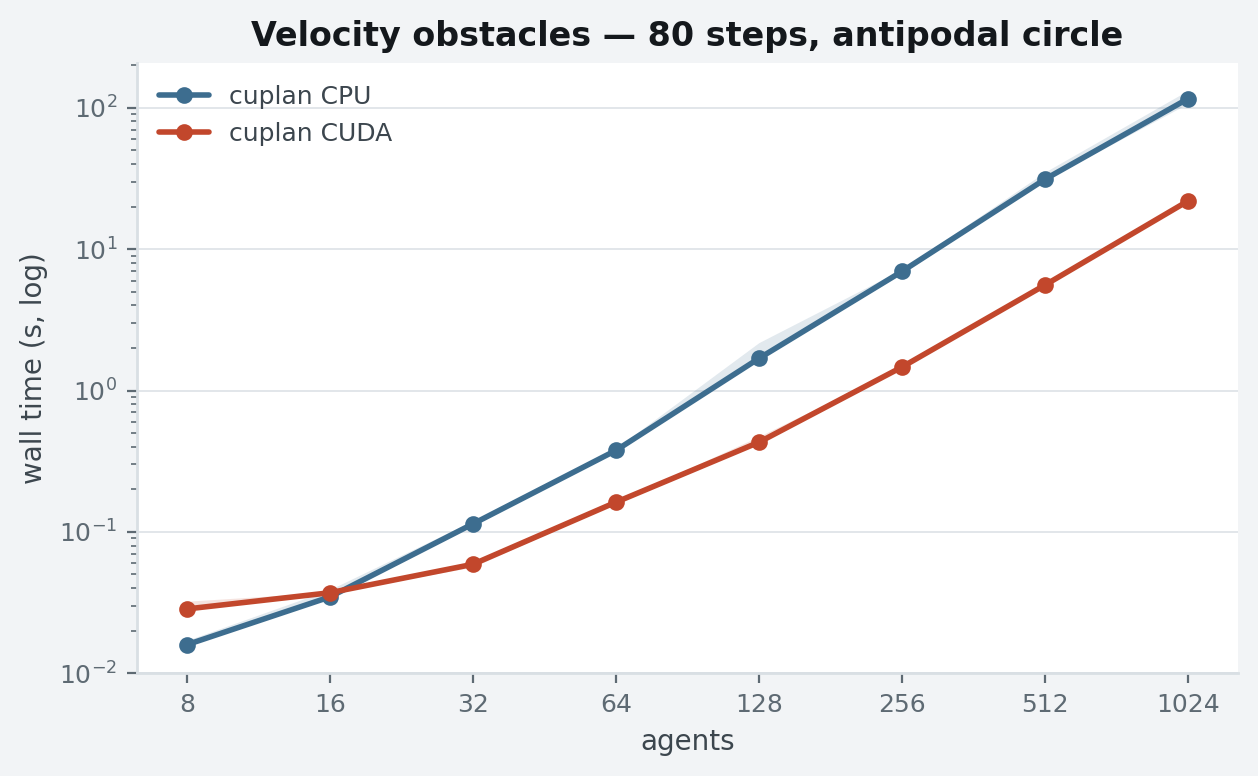
Median wall time for the 80-step run, log–log, 8–1024 agents. The CPU axis stops at 1024 agents (its O(n² × samples) temporaries are the limit, not patience).
| agents | cuplan CPU | cuplan CUDA | ratio |
|---|---|---|---|
| 8 | 0.016 s | 0.029 s | 0.6× |
| 16 | 0.035 s | 0.037 s | 0.9× |
| 32 | 0.114 s | 0.059 s | 1.9× |
| 128 | 1.69 s | 0.431 s | 3.9× |
| 512 | 31.2 s | 5.57 s | 5.6× |
| 1024 | 115.8 s | 21.9 s | 5.3× |
The curve bends exactly where the arithmetic says it should. One step
evaluates agents² × samples collision cones — at 8 agents, with a
20 × 5 velocity sample grid, that is 6 400 tests, far too little to
pay for 80 × 3 kernel launches plus transfers, and the CPU wins.
The crossover sits between 16 and 32 agents (16 is a dead heat:
34.7 ms vs 37.1 ms). From there both backends grow O(n²) — the
parallelism is over agents and samples, but each thread's scan over
the others grows linearly — so the ratio plateaus around 5–6× rather
than growing without bound. The phase breakdown shows
the same story from the inside: at 16 agents the kernel is only 60%
of CUDA wall time; at 1024 agents it is 99.8%.
Two caveats the numbers force. First, 80 steps is a compute budget,
not a task: the start circle's radius grows with the agent count, so
beyond 8 agents the goals are farther than 80 steps can cover at
vmax, and goals_reached is 0 for every run from 16 agents up.
That column measures the budget, not solver failure.
Second, and more seriously, plain velocity obstacles do not keep
the agents apart in this scenario, at any size measured. With
radius = 0.5 the contact distance is 1.0; the median
min_separation over seeds is 0.74 at 8 agents, 0.087 at 16, 0.045
at 64, 0.0097 at 256 and 0.0005 at 512. Agents are interpenetrating
from 16 agents onward. This is the known failure of the
non-reciprocal formulation — every agent assumes the others hold
their velocity, so two agents facing each other both dodge the same
way and the avoidance cancels. Reciprocal variants (ORCA) are on the
roadmap. Read this page as a throughput measurement
of a kernel, not as a claim that the kernel produces safe motion at
scale.
What the run does establish besides speed is backend equivalence: on
all 24 instances CPU and CUDA report bit-identical goals_reached
and min_separation, because the synchronous update rule makes the
step order-independent.