Batched BFS
The primitive underneath everything else — one exact distance map per
source, batched into a single (N, H, W) wavefront — measured alone.
Conditions for the whole page: random grids at 15% obstacle density,
sources drawn from the free space with a fixed seed, seeds {0, 1, 2},
medians with min–max bands, wall time including transfers. CPU runs
stop at 1024 sources (a 2048-map build costs about two minutes per
seed on this CPU); the CUDA axis continues to 2048.
Build time
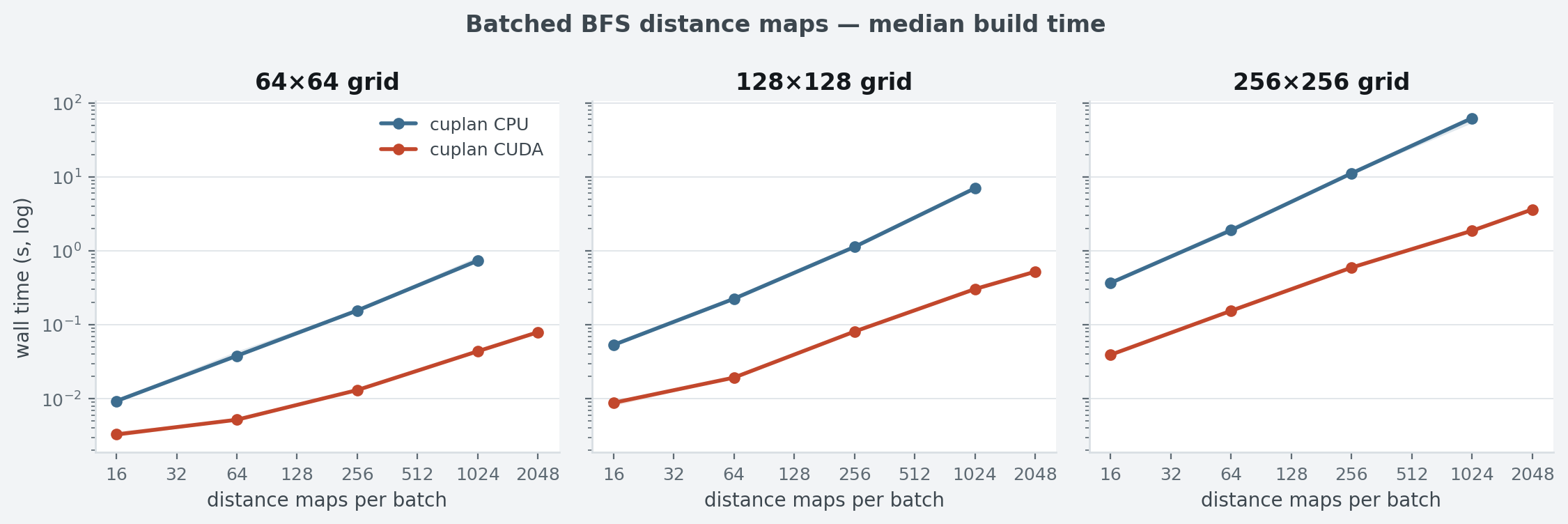
Median build time for a batch of distance maps, log–log. Grids 64², 128², 256² at 15% density; seeds {0, 1, 2}; no timeouts occurred.
Three readings:
- There is no crossover in this family. Even 16 maps on a 64² grid build faster on the GPU (3.3 ms vs 9.3 ms). The workload is born batched — the wavefront advances every map with every sweep — so the kernel is never launch-bound the way the small velocity-obstacle steps are.
- The gap widens with both axes. 17× at (64², 1024 maps), 23× at (128², 1024), 33× at (256², 1024): 62.1 s of NumPy sweeps against 1.87 s on the device. Kernel launches scale with graph diameter, not batch size, so bigger batches amortize the same number of launches over more parallel work.
- The CPU line bends up; the CUDA line does not. CPU throughput
falls as batches grow (1 720 → 1 392 maps/s on 64²) because the
(N, H, W)boolean temporaries outgrow cache, while CUDA throughput rises (4 860 → 25 800 maps/s) as the batch fills the device — the saturation story on the phases and crossover page.
Selected medians
| grid | maps | cuplan CPU | cuplan CUDA | speedup |
|---|---|---|---|---|
| 64² | 1024 | 0.736 s | 0.044 s | 17× |
| 128² | 1024 | 7.00 s | 0.304 s | 23× |
| 256² | 256 | 11.15 s | 0.593 s | 19× |
| 256² | 1024 | 62.09 s | 1.87 s | 33× |
| 256² | 2048 | — (capped) | 3.62 s | — |
Same conditions as the figure. The 2048-map CPU cell was cut for time, not ability — see methodology.
Why this page matters beyond itself: the MAPF solvers consume these tables. pymapf builds the equivalent oracle with one serial Dijkstra per agent, which is most of the gap on the prioritized planning and PIBT pages.