PIBT
PIBT — Priority Inheritance with Backtracking (Okumura, Machida, Défago & Tamura 2022) — is a one-step-at-a-time solver: at every timestep each agent ranks its five moves by distance-to-goal, and conflicts are resolved by letting a higher-priority agent inherit its blocker's decision, backtracking when the inheritance chain fails. There is no path search at all, which makes it very fast and incomplete, and which changes where a GPU can help.
Conditions for the whole page: random grids from random_scenario,
starts and goals in one connected component, seeds {0, 1, 2},
identical instances to all three solvers, medians over seeds with
min–max bands, wall time including host/device transfers, caps of
60 s (pymapf) and 300 s (cuplan). Full protocol on the
methodology page.
Scaling with agents
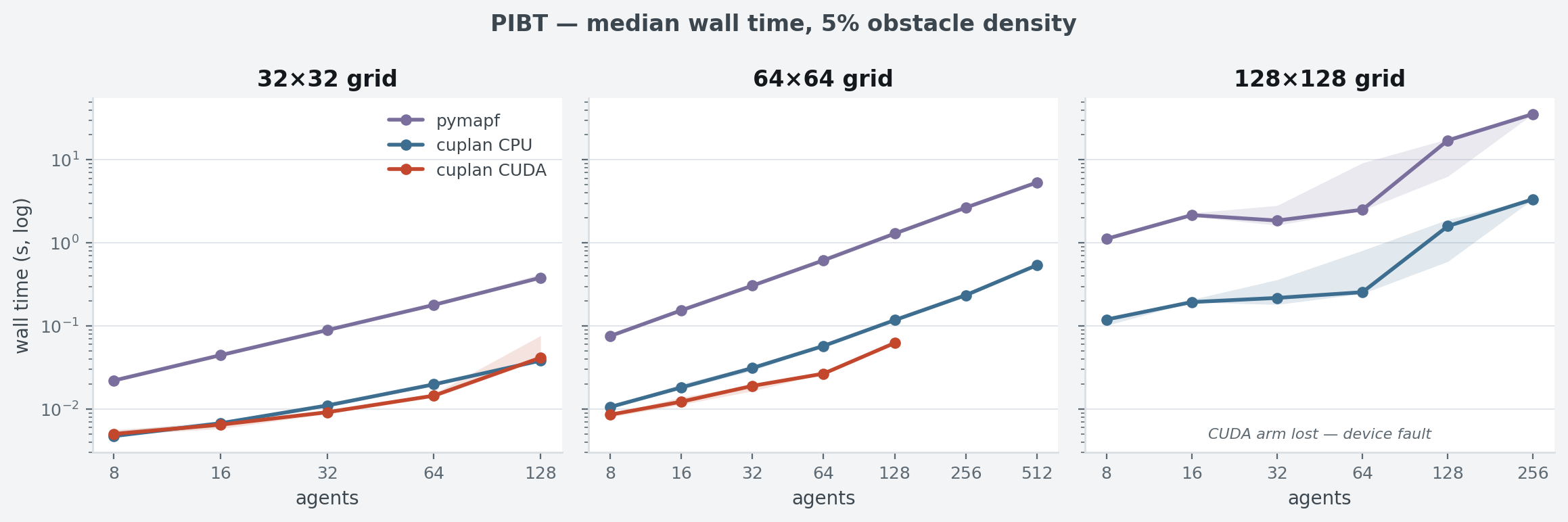
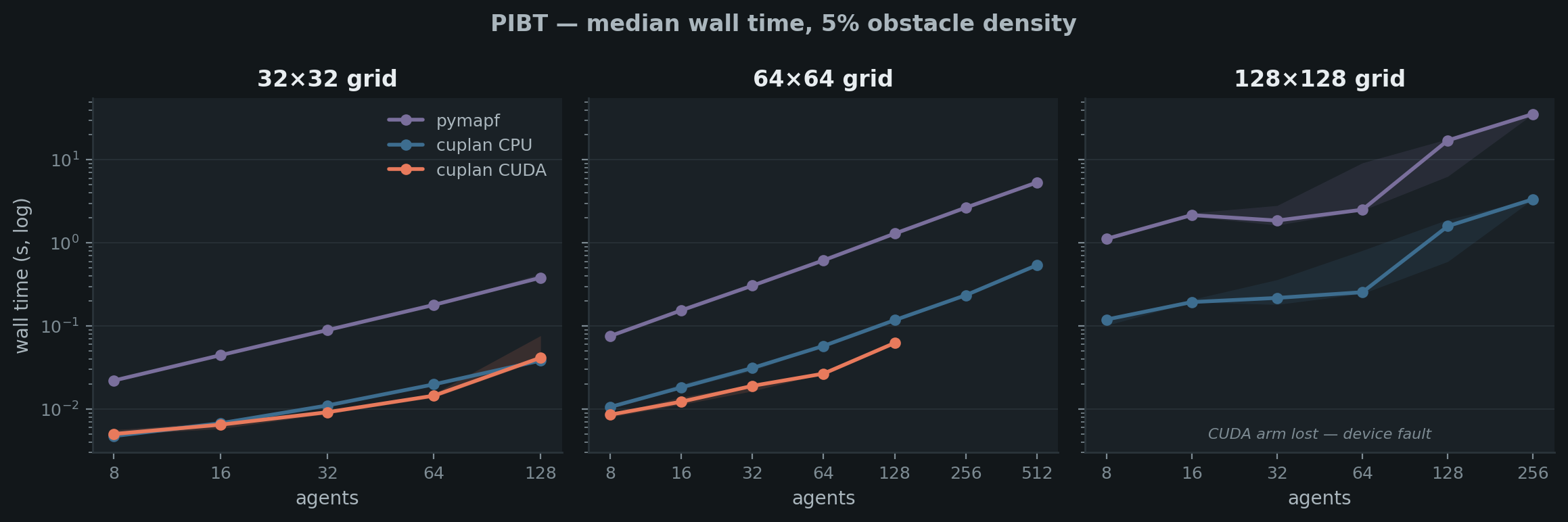
Median wall time, log–log, at 5% obstacle density — the one density reached on all three grids before the sweep was interrupted. Grids 32², 64², 128²; agents 8–512; seeds {0, 1, 2}; bands are min–max over seeds that solved. The 128² panel carries no CUDA line: those cells are on disk as device errors, not as measurements.
PIBT's curves are the flattest in the library, and the flatness is the finding.
Against pymapf the ratio is roughly constant. 7.2× at 8 agents, 9.8× at 32, 10.7× at 64, 11.1× at 256, 9.9× at 512 — all on the 64² grid at 5%. Compare the prioritized planning page, where the same comparison runs from 1.6× to 78× over a narrower range. The difference is structural: prioritized planning's cost per agent grows with how full the reservation table already is, so the gap between a dense array and a growing set compounds; PIBT does a fixed amount of work per agent per timestep regardless of history, so the gap is a constant factor — vectorized NumPy against Python object churn — and stays one.
Against its own CPU backend the GPU wins by grid, not by agents. On the 64² grid CUDA runs 1.2× at 8 agents rising to 2.2× at 64. On the 32² grid it is a coin toss: 0.96× at 8 agents, 1.4× at 64, and 0.92× at 128 — the GPU loses on the largest 32² cell measured.
The reason is that the backend switch moves exactly one thing. In
PIBT the device builds the distance oracle — one batched
BFS, once, before the first timestep — and nothing else: the per-step
candidate gather and the inheritance chains are host NumPy in both
backends, by construction.
So the CUDA margin is capped by the oracle's share of runtime, and
that share is set by grid area. A 32² oracle is 1024 cells per map, a
sub-millisecond job that does not repay handing the grid to a device
and taking n maps back; four times the cells at 64², over roughly
twice the BFS diameter, does. Agents make the host loop longer
without giving the device more to do, which is why the 32² ratio
falls back below 1× at 128 agents.
So for PIBT, backend="cpu" is the right default below roughly a 64²
grid, whatever the agent count — and the ceiling above it is
Amdahl's, not the kernel's.
Neither backend's curve is superlinear in agents. PIBT is O(agents × timesteps) with a small constant, and the timestep count is bounded by the solver's step limit rather than by search depth. The 64² CPU line moves from 0.011 s at 8 agents to 0.54 s at 512: a 64× increase in agents for a 51× increase in time.
Selected medians, 64×64 grid, 5% density
| agents | pymapf | cuplan CPU | cuplan CUDA | CUDA vs CPU | pymapf vs CPU |
|---|---|---|---|---|---|
| 8 | 0.076 s | 0.011 s | 0.0086 s | 1.2× | 7.2× |
| 16 | 0.154 s | 0.018 s | 0.0123 s | 1.5× | 8.5× |
| 32 | 0.306 s | 0.031 s | 0.0190 s | 1.7× | 9.8× |
| 64 | 0.618 s | 0.058 s | 0.0267 s | 2.2× | 10.7× |
| 128 | 1.296 s | 0.118 s | 0.0625 s ² | 2.0× | 11.1× |
| 256 | 2.662 s | 0.235 s | — ¹ | — | 11.1× |
| 512 | 5.348 s | 0.541 s | — ¹ | — | 9.9× |
Medians over 3 seeds unless noted. Ratios are medians of per-seed ratios on instances both solvers solved, so they are not the ratio of the two median columns. ¹ CUDA rows lost to the device fault — see methodology. ² 1 seed of 3; the other two were the first rows the fault touched, so treat this cell as indicative rather than measured.
Note what is not in this table: a timeout. PIBT finished every 64² cell in every library, up to 512 agents. Its failure mode is returning "no plan", not running long.
Density
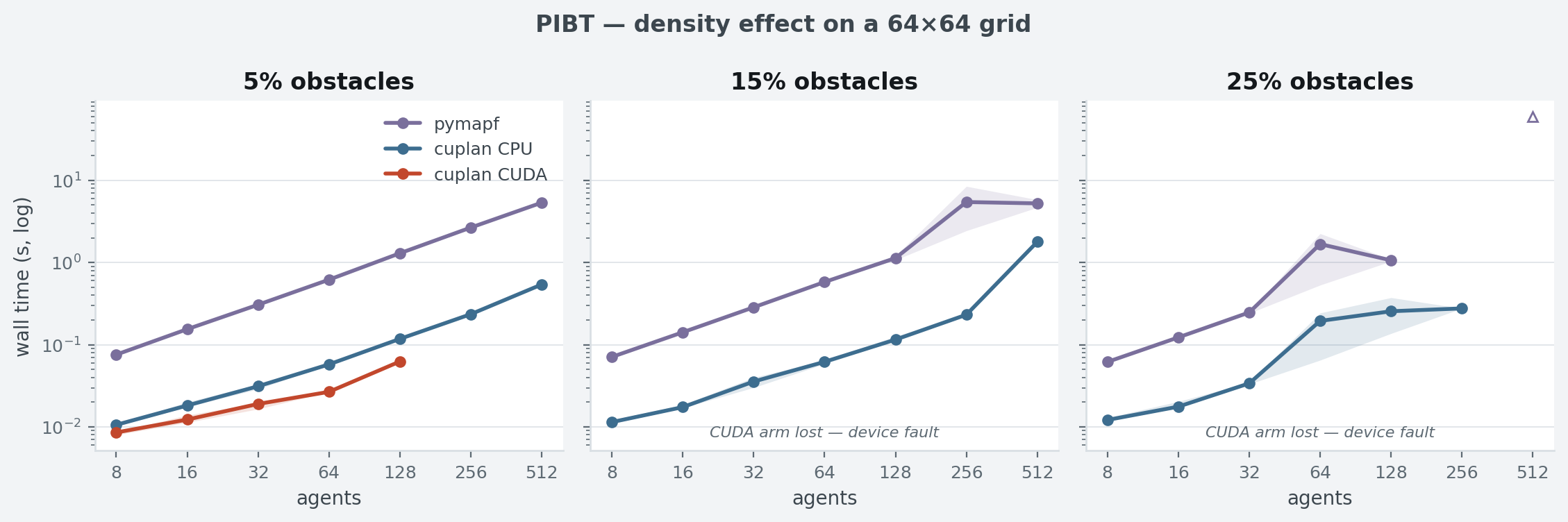
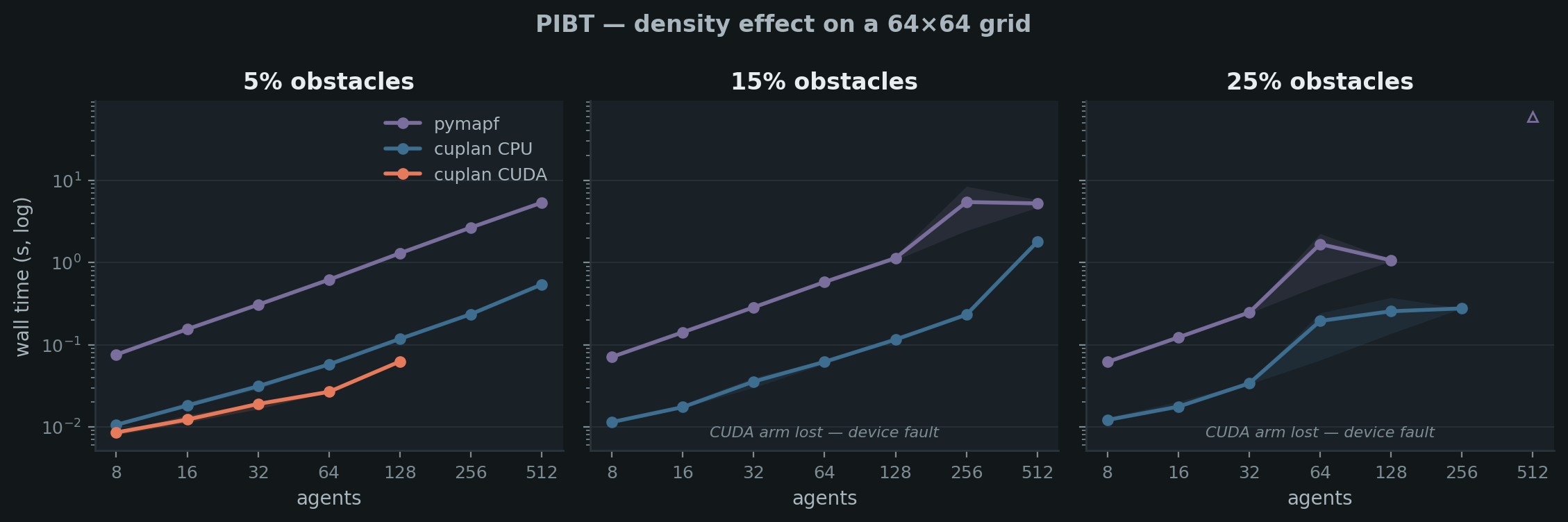
64×64 grid, obstacle density 5% / 15% / 25%, agents 8–512, seeds {0, 1, 2}, shared y-axis. The 15% and 25% panels carry no CUDA line: the device fault reached the sweep before those cells ran.
This is the figure where PIBT's shape changes, and it is worth reading carefully because the y-axis is medians over solved seeds only.
At 5% the CPU line is a clean straight log–log run. At 25% it kinks upward hard between 32 and 64 agents — 0.034 s to 0.195 s, a 5.7× jump for a 2× agent increase — and then goes flat, 0.255 s at 128 and 0.277 s at 256. That flat tail is a selection effect, not a plateau: at 128 agents one of three seeds failed and at 256 two of three failed, and the failing seeds are the slow ones. Per-seed at (64², 25%, 256 agents) the two failures took 2.21 s and 2.18 s while the single success took 0.276 s. The median of solved runs hides an order of magnitude.
The mechanism is priority inheritance. In open space a blocked agent steps aside and the chain is one link long. Pack agents into a quarter-blocked grid and the chains lengthen, backtrack, and eventually exhaust the step limit — so wall time and failure rate rise together, and quoting either one alone is misleading. This is why the success figure and the timing figure belong on the same page.
Success rate
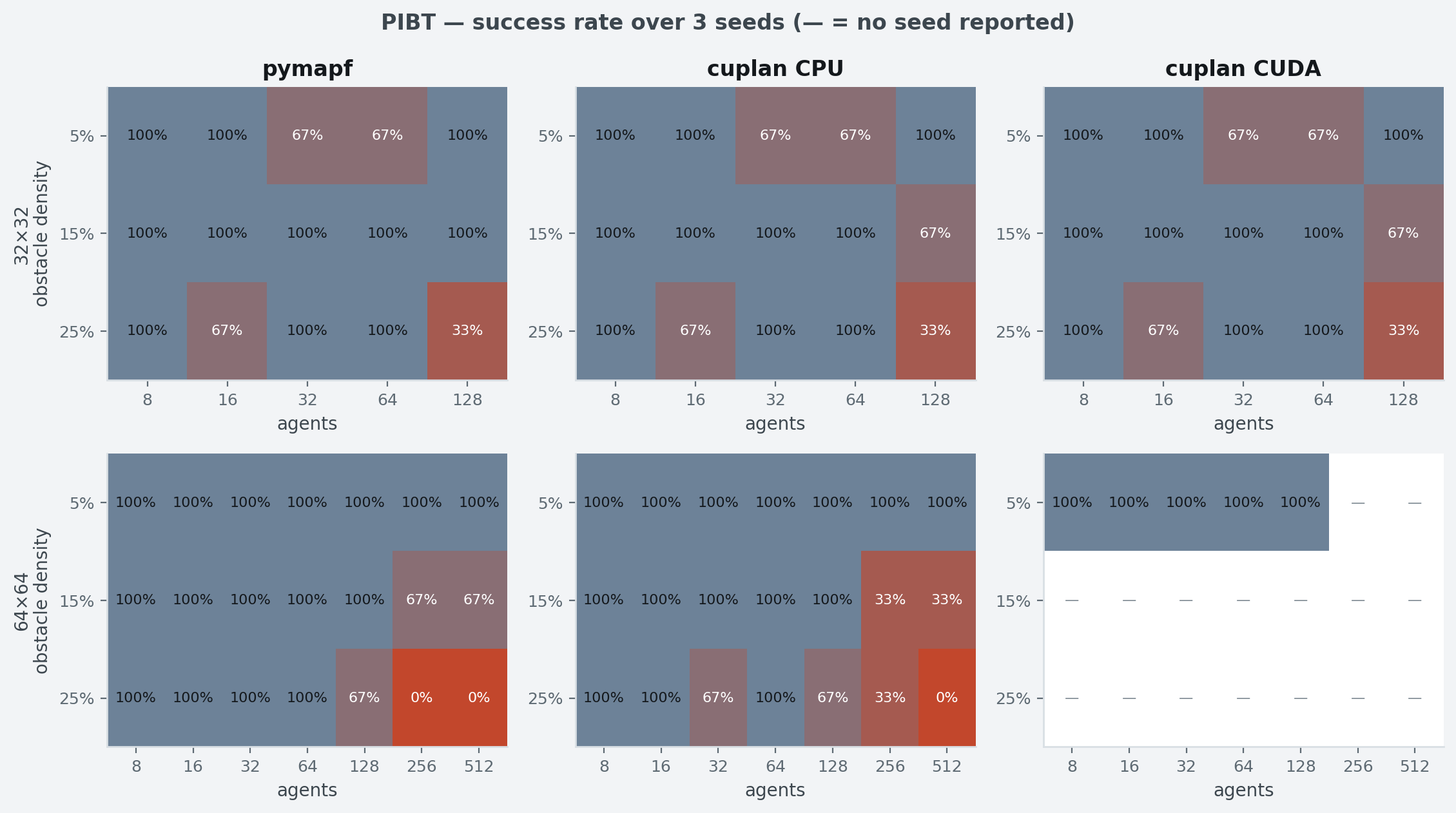
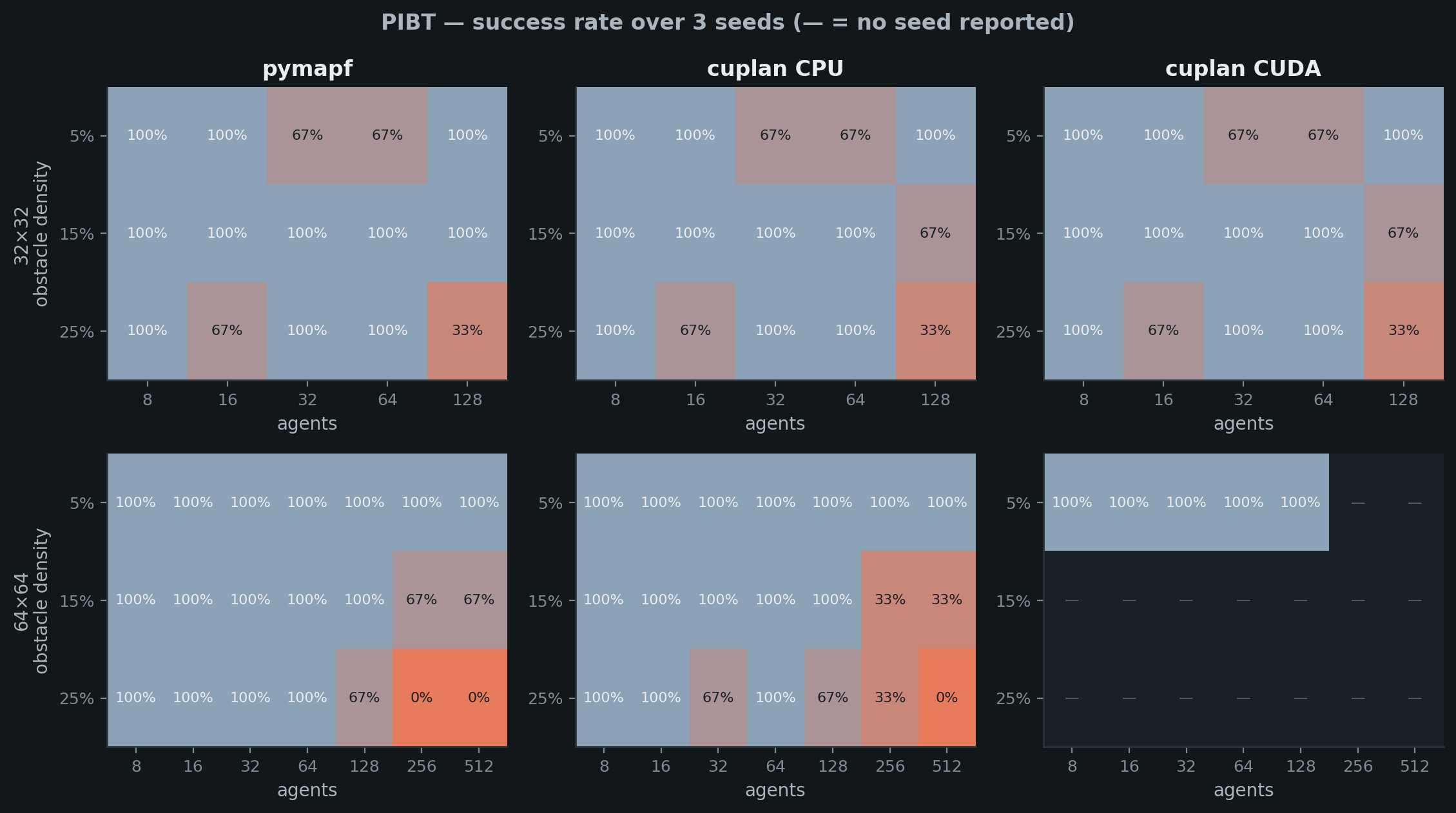
Fraction of seeds returning a plan that passes cuplan's independent validator. Rows are grids (32², 64²), columns are solvers, cells are agents × obstacle density over seeds {0, 1, 2}. Timeouts count as failures — the two at (64², 25%, 512) for pymapf. Every em dash in this figure is cuplan CUDA at 64², lost to the device fault; PIBT never triggered pymapf's timeout escalation, so no pymapf cell is missing.
On the 32² grid the three solvers agree on 14 of 15 cells, non-monotone ones included: 67% at (32 agents, 5%), 100% at (32, 15%), 67% at (16, 25%), 33% at (128, 25%). PIBT's outcome is decided by the inheritance chain, which is decided by the instance, so independent implementations of the same rule fail the same draws.
The fifteenth cell is the interesting one. At (32², 15%, 128 agents) pymapf solves all three seeds and both cuplan backends solve two. That is a genuine difference, and it is a tie-break: when two moves score equally, which one an agent takes decides whether the chain that follows terminates. cuplan does not claim to dominate pymapf on success rate, and here it does not.
The same asymmetry is larger on the 64² grid at high density. At (64², 15%, 256 and 512 agents) pymapf reaches 67% where cuplan CPU reaches 33%; at (64², 25%, 128) pymapf and cuplan both sit at 67%, but at 256 agents cuplan gets one seed and pymapf gets none. Neither ordering is stable — these are 3-seed cells, resolved to ±33% and no finer, and reading a ranking out of them would be over-reading. What is stable is the shape: both libraries fall off the same cliff between 128 and 512 agents once the grid is a quarter blocked.
The honest reading of the timing table above is therefore conditional. PIBT solves 512 agents on a 64² grid in 0.54 s at 5% density, where every seed succeeds. At 25% density it solves none of them.
Solution quality
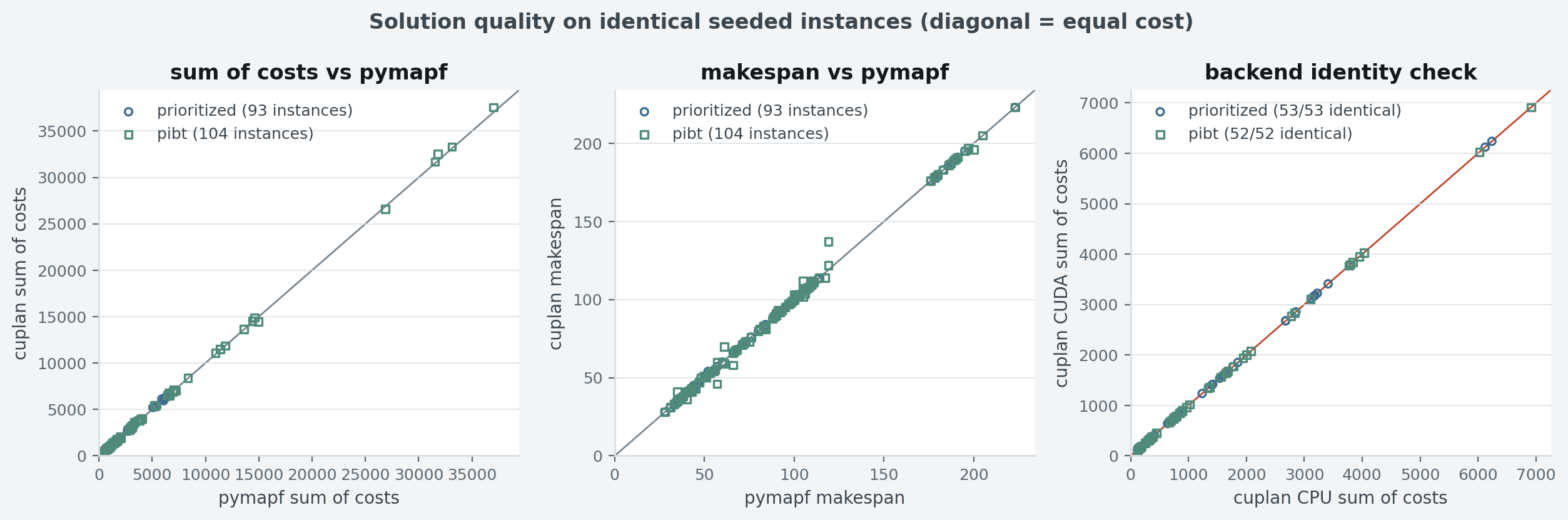
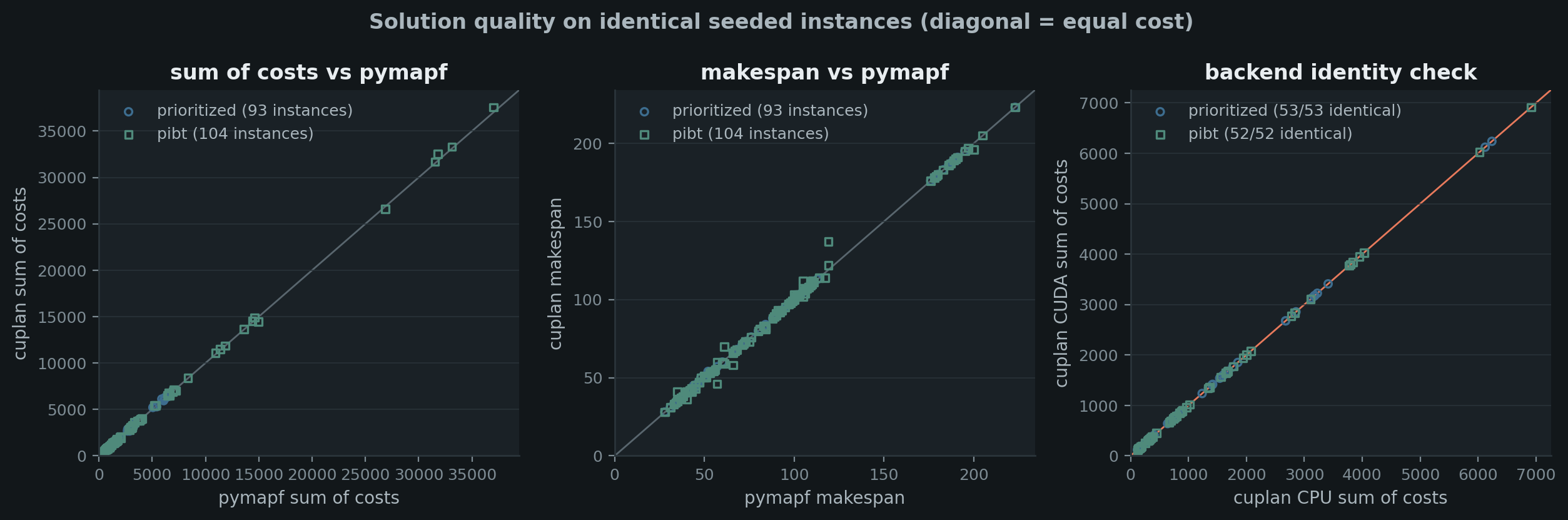
Every instance solved by both solvers, both MAPF families pooled: 93 prioritized and 104 PIBT instances for the pymapf panels, 53 + 52 for the backend check. Grids 32²–128², all three densities, seeds {0, 1, 2}. Diagonal = equal. Square markers are PIBT.
On the 104 shared PIBT instances the median cuplan/pymapf sum-of-costs ratio is 1.0000, spread 0.882× to 1.126×; makespan spreads wider, 0.807× to 1.171×. cuplan is cheaper on 39% of instances and dearer on 48%, and only 13% match exactly — a much looser cloud than prioritized planning's.
That looseness is expected and is not a defect. PIBT resolves ties between equally-good moves, and a tie broken differently at timestep 3 sends two agents down different corridors for the rest of the run. The plans diverge; the cost does not, systematically, in either direction. What would be a defect is a cloud that sat off the diagonal, and it does not.
The backend check is again exact: on all 52 of 52 shared instances, cuplan's CPU and CUDA backends return identical sum of costs and identical makespan. That is guaranteed rather than observed: the only thing the backend switch moves is where the distance oracle is built, and the oracle is an exact integer distance table — the same integers either way. Every decision after it, ranking included, runs on the host from the same seeded RNG.
What to take away
- PIBT is the family to reach for when you need a plan in milliseconds and can accept failure on crowded instances: 512 agents on a 64² grid at 5% density, 0.54 s on the CPU backend.
- The GPU buys ~2× at 64², nothing reliable at 32², and the crossover
is set by grid area, not agent count. Below 64², pass
backend="cpu". - Quote PIBT timings with the density attached. At 25% on a 64² grid the same solver fails outright above 256 agents, and the timings of the runs that did succeed are not representative of the ones that did not.